

Thus far in this experimental trends tracking project, I often get the question: “Improving or Declining… compared to what?” At which point questions about baseline arise. When I think of this exercise, however, I consider it to be more like tracking symptoms of an illness comparing one week to the next. A healthcare analogy perhaps captures it best.
The Power of Symptom Recognition
When you walk into urgent care with chest pain, the medical team does two things simultaneously: they check your vital signs against established standards (blood pressure should be under 140/90, heart rate between 60-100 bpm) AND they ask about the symptoms you are experiencing that signal the potential source of the problem. They don't need to diagnose your exact condition to know that chest pain plus shortness of breath requires urgent attention—these are established symptoms that medical professionals recognize as warning signs even before they determine the specific cause.
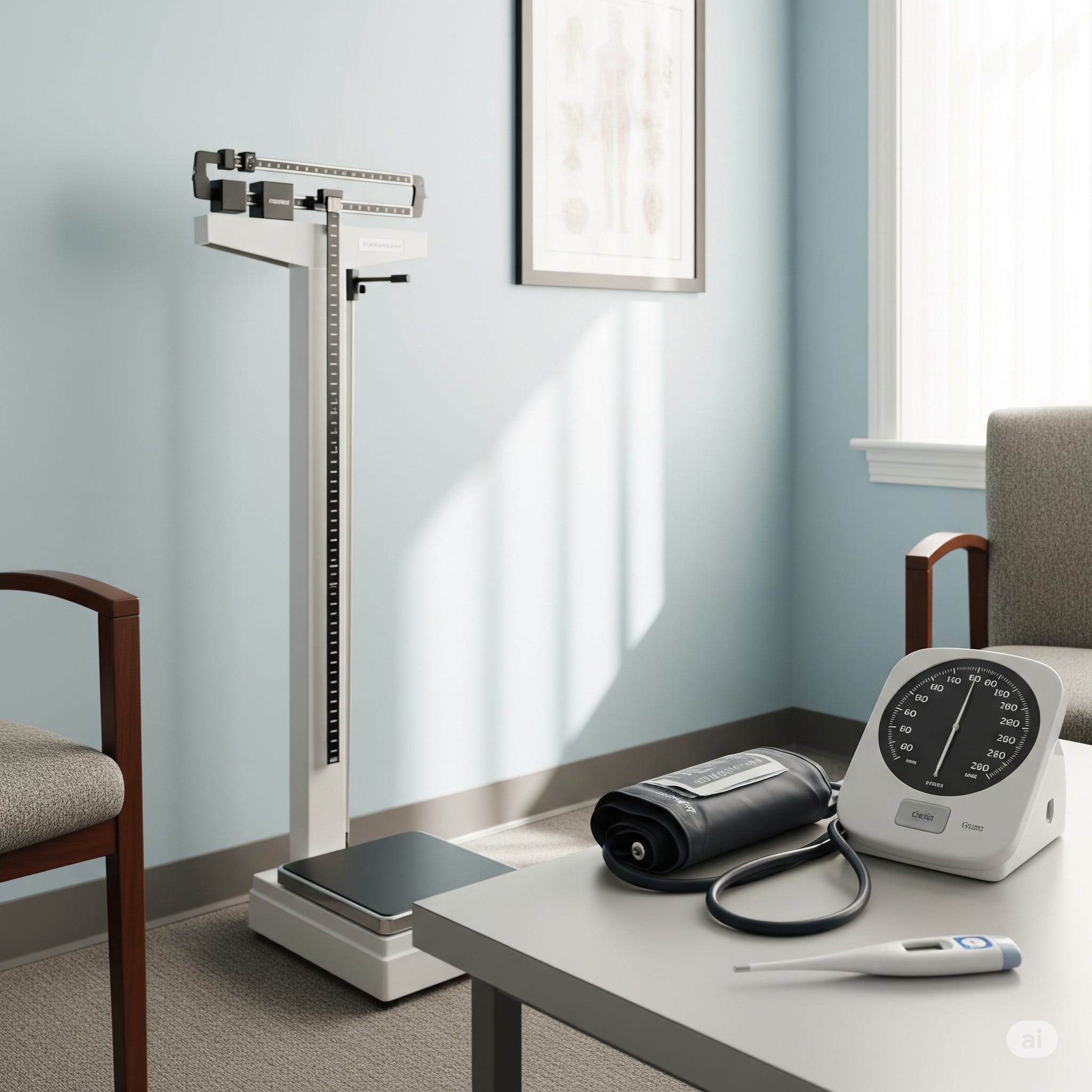
Democratic monitoring works the same way. There are measures that track US democratic vitality over time to establish normal ranges and baselines, like V-Dem, Freedom House, and Bright Line Watch. And then we have RealTime DemTrends to pick up on the classic symptoms of concern or progress that signal democratic erosion or consolidation.
Just as medicine has developed comprehensive lists of symptoms that signal potential problems—upset stomach, shortness of breath, sudden confusion—democracy has identifiable symptoms of concern or progress that warrant attention regardless of the final "diagnosis."
Symptoms like:
Mass firing of career civil servants (signals potential agency politicization)
Courts blocking multiple executive actions (signals tension in the balance of powers across branches)
Government agencies spreading contested information (signals information integrity stress)
Journalists reporting harassment or being arrested (signals media freedom erosion)
When we see these warning signs, we can begin to flag emerging challenges or opportunities for the US democratic system even before we can definitively assess their long-term impact on overall democratic health.
The added value of symptom monitoring is that potential problems or patterns of behavior can become visible long before they register in annual assessments. A patient might have normal blood pressure during their annual physical, but if they call their doctor reporting sudden chest pain and dizziness, that otherwise normal pattern combined with these symptoms demands immediate attention—not waiting for next year's checkup.
Why We Need Both Standards and Symptoms
Democracy indices like Bright Line Watch, V-Dem, or Freedom House provide crucial baseline standards—telling us whether core democratic institutions meet established thresholds. For example, V-Dem measures judicial independence by asking experts "When the high court in the judicial system is ruling in cases that are salient to the government, how often would you say that it makes decisions that merely reflect government wishes?" (with responses from "Always" to "Never") and measures electoral integrity through indicators like election turnout percentages. These standards are essential for knowing when we're in dangerous territory.
But standards alone miss a critical question: What's changing right now?
Consider these scenarios:
Scenario A: A country meets most democratic standards (scores 85/100) but institutions are stable with no major changes this week
Scenario B: A country meets most democratic standards (scores 83/100) but this week shows courts actively blocking executive orders, agencies experiencing mass layoffs, and journalists reporting retaliation and being arrested
Both countries look similar on annual assessments, but Scenario B shows active system stress that needs immediate attention. The real-time symptoms reveal dynamics that annual or even quarterly assessments may not pick up until it’s too late.
The Medical Analogy: Standards, Symptoms, and Family Observations
Beyond standards setting and symptom monitoring, doctors—and democracy scholars—use other types of data to make a diagnosis. Consider a patient in urgent care:
Medical vitals show normal readings (blood pressure 120/80, heart rate 75)
Clinical symptoms observed by medical staff show no immediate distress
But the patient's mom reports: "He's been acting completely different this week - confused, irritable, not himself at all"
And long-term family observations: "We've noticed he hasn’t been taking his medicine every day, and he started skipping appointments this past year too. He seems to be weary of his doctors."
The medical team has objective measurements, direct clinical observations, but they also need the perspective of the people who see the patient daily and can spot changes or strange behavior that wouldn’t necessarily show up in standard tests or be reported by the patient as a symptom. In medicine, family input is crucial—they might spot personality changes, cognitive decline, or behavioral patterns that don't show up in standard tests but signal something important is happening.
This is exactly how democratic assessment works. We need:
Democratic standards (are courts, elections, and agencies meeting the standard?)
Symptoms signaling concern or progress (what changes are visible in institutional behavior this week?)
Public observation (how do citizens, who make up and experience US democracy ebb and flow daily, assess what they're seeing?)
Long-term public assessment (is public confidence in the democratic system changing over time?)
The Four Types of Data on Democratic Vitality
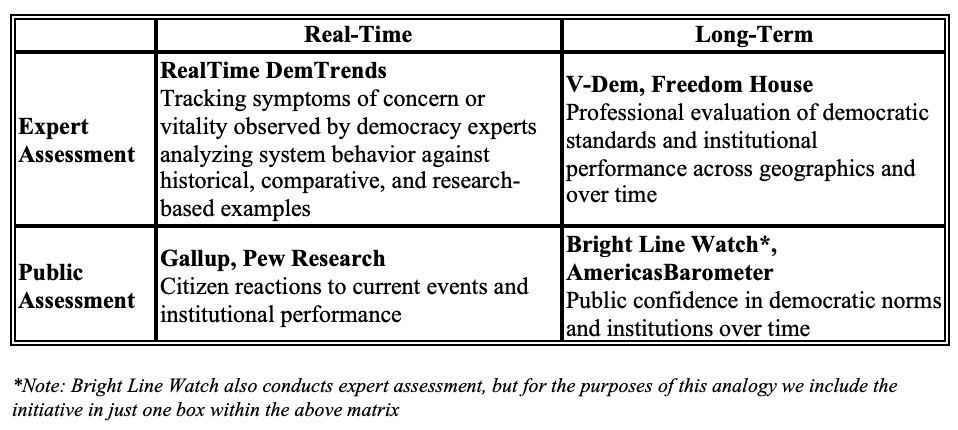
The Combination of Datapoints is Essential
Democratic standards, symptoms signaling concern or progress, and public observation and assessment are all critical—and they work best together.
When V-Dem or Bright Line Watch show that the United States still meets most democratic standards, but has been experiencing a gradual decline in some indices, they are providing us with a baseline standard for comparing and contrasting democratic vitality across countries and over time. When RealTime DemTrends reports that judicial independence shows progress (+1) while agency politicization shows concern (-2) in the same week, these are symptoms of potential opportunities or problems emerging. When weekly polling from sources like Gallup and Pew Research shows 60% approve of the President's handling of a crisis, that's a helpful observation of democracy's health from those who experience the system daily. When AmericasBarometer tracks how public support for democratic institutions shifts over time, that's the type of year-over-year opinion tracking that can tell us if trust in the system is waning.
Combined, these datapoints create a complete assessment of US democratic vitality. It's like urgent care doctors having medical test results, clinical observations, the family's immediate concerns, and the family's long-term observations about changes in behavior.
The Complete Picture
Just as urgent care needs medical test results, clinical observations, and family input, democracy monitoring requires institutional standards, real-time symptoms monitoring, and both immediate and long-term public assessment.
V-Dem tells us: "America's constitutional system still functions within normal ranges, but separation of powers shows concerning trends"
RealTime DemTrends tells us: "This week, federal courts blocked executive actions (+1 Rule of Law) while agencies faced unusual political direction (-2 Agency Politicization)"
Gallup and Pew Research tell us: "Citizens are split 55-45 on whether the Supreme Court is too political after this week's ruling"
Bright Line Watch/AmericasBarometer tell us: "Public confidence that the Constitution limits executive power has declined 15 points over three years"
Each perspective is essential. Together, they provide the complete information democracy watchers need. Just like urgent care needs multiple perspectives to make good decisions about patient care, American citizens need all of these datapoints to engage effectively in civic life and electoral and political processes.
What This Means for Readers of RealTime DemTrends
As you read the RealTime DemTrends weekly analysis, think of the 39 factors we track as the sub-systems, such as judicial independence, civic engagement, and respect for human rights that make up the overall US democratic system—akin to the body’s digestive system, nervous system, or circulatory system. When we flag factors like "Rule of Law +1" or "Agency Politicization -2," we're reporting on the symptoms of concern or progress for the US democratic system, and we are using a comprehensive framework to determine whether the symptom is minor (+/-1), moderate (+/-2), or severe (+/-3).
To avoid confusing this symptom tracking exercise with formal trendline analysis compared to an established baseline, you’ll see this week and future posts shift from:
“minor decline” —> “minor concern”
“minor improvement” —> “minor progress”
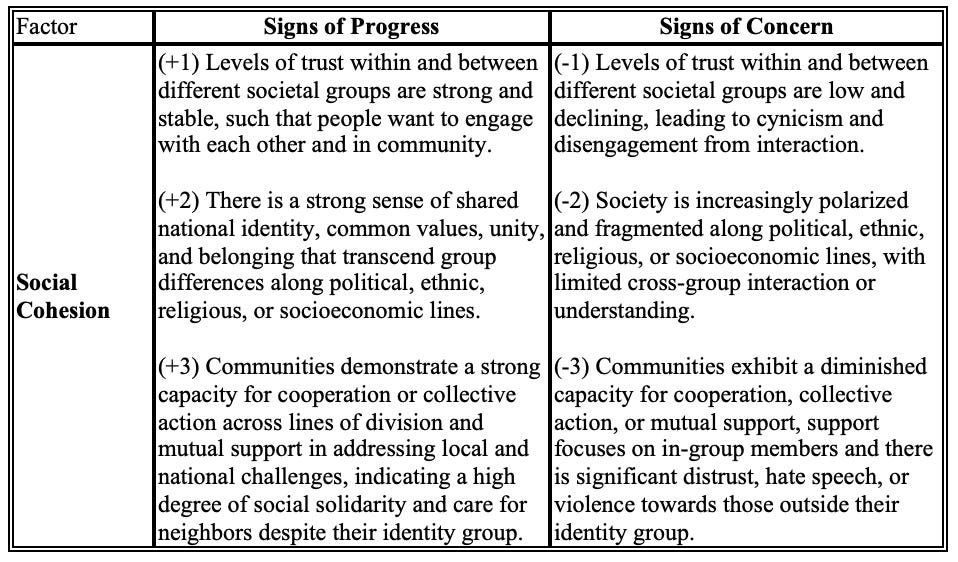
Here is an example of the type of ‘symptoms’ that AI searches for in the news each week to flag potentially relevant articles indicative of concern or progress for the “Social Cohesion” factor.
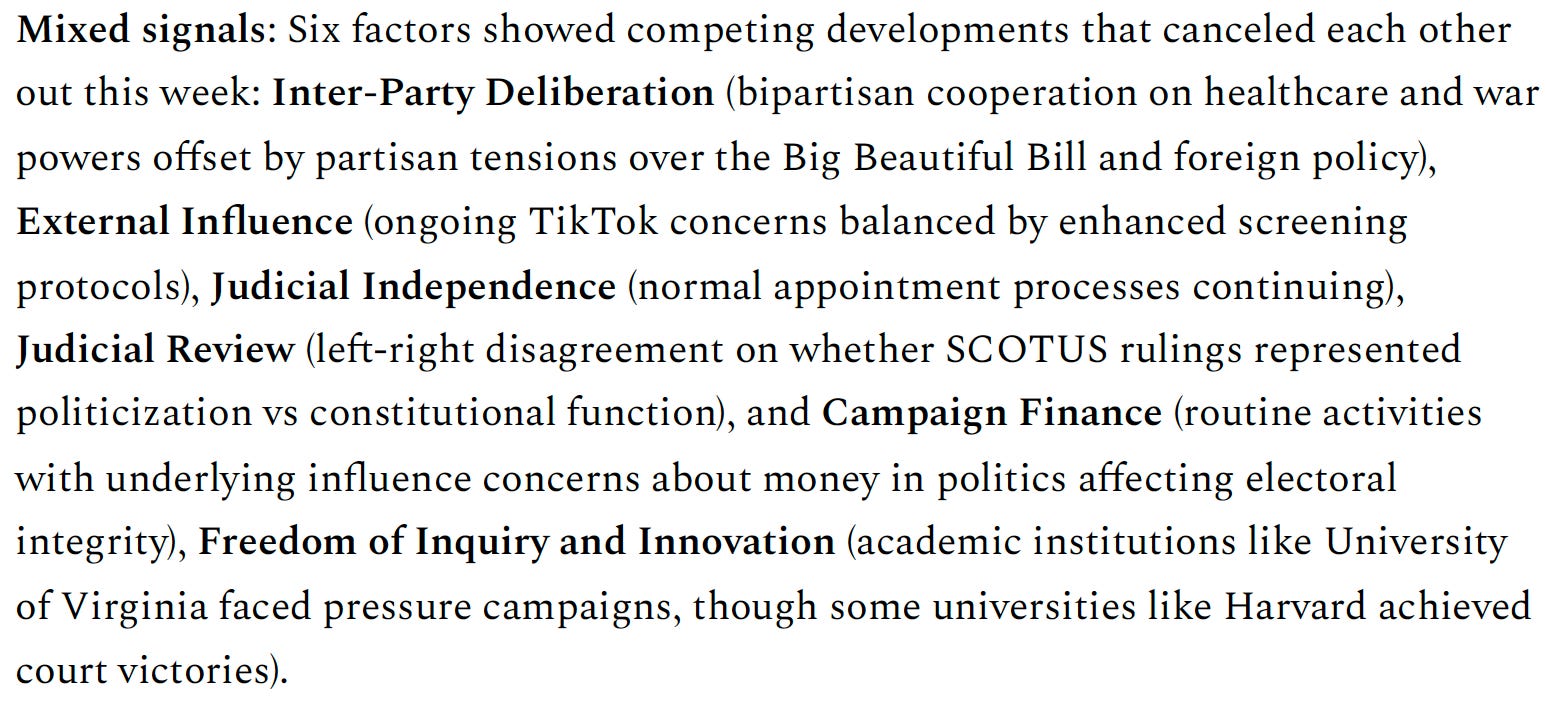
And when multiple events in the past week impact the same factor, in different ways, we report on the difference both at the factor and dimension level, as demonstrated below.
From the week of June 23rd (factor level, in narrative):
From the week of July 14th (dimension level, in heatmap):

Monitoring these symptoms matters because:
Real-time intelligence: Potential problems show up long before they register in annual assessments
Actionable information: Patterns of symptoms can point to specific areas needing attention, particularly as revealed through the weekly factor analysis and systems map that shows which factors or events are central to the system and which are more isolated
Context for standards: Weekly events and dynamics can help explain how and why annual scores might be shifting
Does This Project Fill a Data Gap for You and Your Work?
If so, please subscribe and pledge your support for this weekly analysis to monitor shifts in political accountability with implications for US democratic vitality.
What do you think? Does this medical analogy help clarify why we focus on weekly shifts rather than overall democratic scores? I'd love to hear your thoughts on how baseline assessments and symptom monitoring can work together to strengthen democratic resilience.