

Two hundred and fifty years ago this week, a committee of five men handed the Continental Congress a document that would become one of the most consequential arguments about government ever committed to paper. It was not, at that time, a statement of what America was. It was a detailed account of what it was escaping — and an aspirational vision of what the founders intended to build in its place.
At RealTime DemTrends, we have spent the past year tracking 39 political accountability factors signaling progress or concern for U.S. democratic vitality, by publishing weekly AI-assisted and human expert verified analyses drawing upon real-time news article evidence from across the political spectrum.
On this 250th anniversary of the Declaration of Independence, I am returning to the source for clarity and hope. What did the founders say they were rejecting? What did they say they were building? And what does a full year of U.S. democratic vitality monitoring data say about where we stand?
The answers are clarifying in ways that feel both sobering and, in a few places, unexpectedly encouraging.
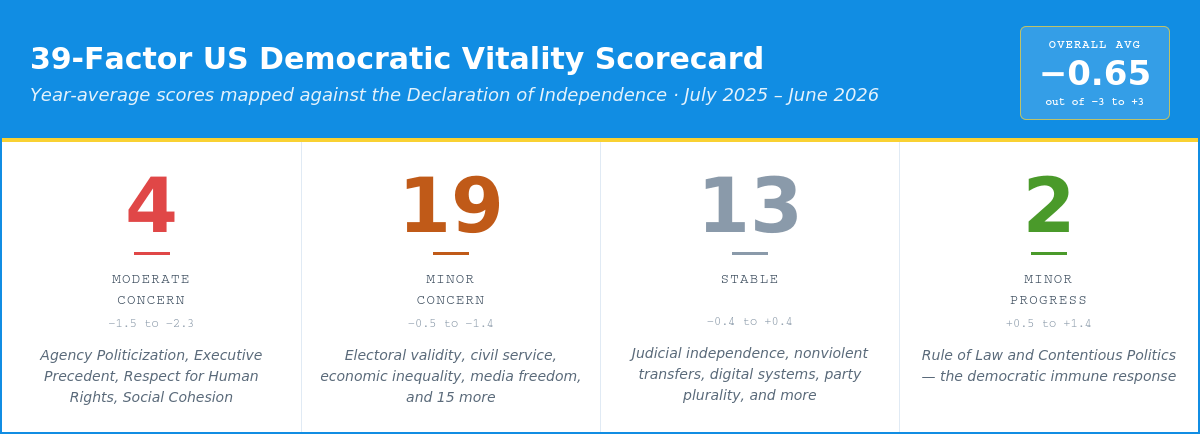
Bottom line up front: A full year of weekly data — 39 factors, 50,000+ articles, 15 cross-spectrum sources — places the United States at aggregate −0.65 average on our −3 to +3 democratic vitality scale. Across the aggregated averages by factor, four fall in the range of moderate concern, nineteen in minor concern, thirteen predominantly stable, and two in minor progress. The founders documented the same three types of dynamics we track — tyranny patterns, structural safeguards, and democratic aspirations — in this foundational Declaration 250 years ago. The data reveals that we are feeling the strain on all three.
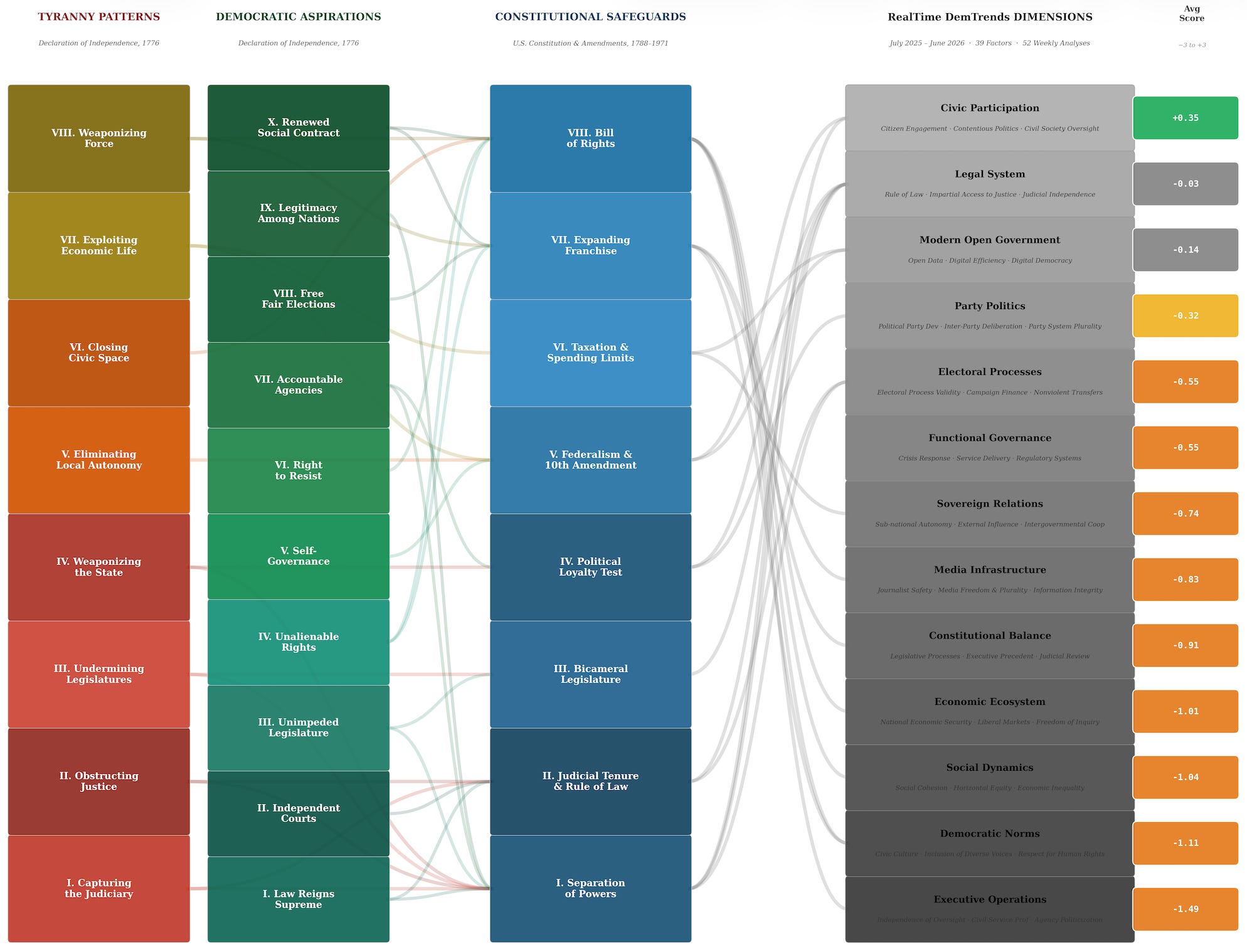
Skip ahead:
The tyranny they fled
The Declaration is not abstract political philosophy. More than half its text is a specific, bulleted indictment — 27 grievances logged against the English King. Understanding what kinds of transgressions made it into that list reveals what the founders considered the core failures of a despotic government.
The Declaration’s prose is deliberate: the preamble articulating natural rights and a future vision to galvanize the public masses occupies just two paragraphs. The remaining body of the document offers a detailed account of a pattern of abuse serious enough to justify what the founders acknowledged was an extraordinary act: dissolving the bonds of political allegiance.
What did tyranny look like to the founders? Reading the grievances carefully, eight patterns emerge. Each maps directly to a failure of political accountability that RealTime DemTrends continues to watch out for today.
Tyranny Pattern I: Obstructing justice
“He has obstructed the Administration of Justice, by refusing his Assent to Laws for establishing Judiciary powers.”
Creating courts — and then blocking their operation — was listed among the gravest acts of the king. Access to independent legal remedy was non-negotiable.
Relevant Factors: Rule of Law · Impartial Access to Justice
Tyranny Pattern II: Capturing the judiciary
“He has made Judges dependent on his Will alone, for the tenure of their offices, and the amount and payment of their salaries.”
A judiciary that served at the will and pleasure of the executive could not be an impartial adjudicator. Judicial independence was a foundational, core principle of a resilient democratic republic in the eyes of the founders.
Relevant Factors: Judicial Independence · Judicial Review and Constitutional Adjudication
Tyranny Pattern III: Undermining legislatures
“He has dissolved Representative Houses repeatedly, for opposing with manly firmness his invasions on the rights of the people.”
The King’s active circumvention of the legislature through sheer and unapologetic exercise of power was identified as categorically tyrannical. The founders expected the executive to respect their choice of elected representatives.
Relevant Factors: Legislative Processes · Executive Precedent · Inter-Party Deliberation and Respect
Tyranny Pattern IV: Eliminating sub-national autonomy
“For taking away our Charters, abolishing our most valuable Laws, and altering fundamentally the Forms of our Governments.”
Eliminating regional and local communities’ right to govern themselves within their jurisdictional sphere undermined the legitimacy of the King’s rule over a distant, foreign land across the Atlantic. The founders did not want to be ruled over by an autocrat with little understanding of their daily lived reality in the colonies.
Relevant Factors: Sub-national Autonomy · Intergovernmental Cooperation · Regulatory Systems
Tyranny Pattern V: Weaponizing the state
“He has erected a multitude of New Offices, and sent hither swarms of Officers to harrass our people, and eat out their substance.”
Agencies redirected from public service to political enforcement — serving the ruler rather than the law — were explicitly named as tools of oppression. The founders rejected weaponization of the power of the state-administered apparatus.
Relevant Factors: Agency Politicization · Independence of Oversight Bodies · Civil Service Professionalism
Tyranny Pattern VII: Use of force against the people
“He has endeavoured to prevent the population of these States; for that purpose obstructing the Laws for Naturalization of Foreigners; refusing to pass others to encourage their migrations hither… He has plundered our seas, ravaged our Coasts, burnt our towns, and destroyed the lives of our people. He is at this time transporting large Armies of foreign Mercenaries to compleat the works of death, desolation and tyranny… He has constrained our fellow Citizens taken Captive on the high Seas to bear Arms against their Country, to become the executioners of their friends and Brethren, or to fall themselves by their Hands.”
When the state deploys coercive force against those it is supposed to protect, violence against citizens transforms from an aberration into an instrument of rule. The founders held that a legitimate government secures the safety of its people — and that physical or structural violence against some colonists or those migrants chasing the American dream was an assault on all.
Relevant Factors: Respect for Human Rights · Horizontal Equity · Inclusion of Diverse Voices
Tyranny Pattern VII: Exploiting economic life
“For imposing Taxes on us without our Consent... For cutting off our Trade with all parts of the world.”
The King used control of taxation and commerce not to build prosperity but to extract wealth from the colonies and sever their economic independence. The founders understood that economic self-determination — the ability to tax oneself fairly, trade freely, and build domestic resilience — was inseparable from political freedom.
Relevant Factors: Economic Inequality · National Economic Security · Liberal Markets · Regulatory Systems
Tyranny Pattern VIII: Closing civic space
“Our repeated Petitions have been answered only by repeated injury.”
When civil society’s calls for accountability were systematically answered with further harm, and formal channels of redress were met with escalating reprisal, the social contract between the colonists and the English government was broken.
Relevant Factors: Civil Society Oversight · Contentious Politics and Popular Mobilization · Independence and Safety of Journalists
“When a long train of abuses and usurpations, pursuing invariably the same Object evinces a design to reduce them under absolute Despotism, it is their right, it is their duty, to throw off such Government, and to provide new Guards for their future security. —Such has been the patient sufferance of these Colonies; and such is now the necessity which constrains them to alter their former Systems of Government. The history of the present King of Great Britain is a history of repeated injuries and usurpations, all having in direct object the establishment of an absolute Tyranny over these States.”
Declaration of Independence, 1776
Two things are worth noting. First, the founders were not theorizing — they were documenting specific authoritarian behaviors they had personally observed, resisted, and petitioned against through every available legitimate channel. Second, they were explicit that no single grievance was the source of their discontent. The indictment was about a consistent pattern of autocratic behavior, its cumulative effects, and the intention behind all of it.
This is, incidentally, exactly the dynamic that RealTime DemTrends was designed to monitor: we are not declaring a crisis tied to any one event or development each week, instead we track patterns over time across 39 political accountability factors, watching for whether those events are isolated or indicative of a systemic pattern of democratic erosion or progress toward the aspirations articulated in 1776.
The safeguards they built — and how they have held
Between the Declaration’s indictment in 1776 and the realities of independent rule and governance the founders encountered an engineering challenge: how do you build institutions durable enough to protect liberty across generations, against the predictable tendency of those who hold power to accumulate more of it? The answer took more than a decade to work out — and it has been contested, amended, and stress-tested ever since.
The founders were not naive about human nature. The Declaration itself is a document born from the exhaustion of every legitimate option — from years of petitioning, remonstrating, and appealing through formal channels that were systematically closed. They understood that good intentions were not enough, and that aspirations without architecture were just wishes.
The U.S. Constitution, ratified in 1788 — twelve years after the Declaration — translated the founders’ grievances into structural safeguards. Where the Declaration said “He has made Judges dependent on his Will alone,” Article III of the Constitution answered with lifetime tenure and protected salaries for federal judges. Where the Declaration said “He has dissolved Representative Houses,” Article I answered with a Congress that the executive cannot dismiss. Each tyranny pattern named in the Declaration became, in the constitutional design, a prohibition with institutional teeth.
Safeguard I · Separation of powers
Three co-equal branches, each with independent constitutional authority and the power to check the others. No single person or office controls legislation, execution, and adjudication for good reason — to constrain the autocratic tendencies of ambitious political leaders. The founders designed friction into the system deliberately. The 22nd Amendment (1951) added what the founders had notably left out: a two-term presidential limit, preventing the permanent executive entrenchment they had feared.
Relevant Factors: Judicial Review and Constitutional Adjudication · Legislative Processes · Executive Precedent
Safeguard II · Judicial tenure and supremacy of the law
The founders gave federal judges lifetime tenure and constitutionally protected compensation for a precise reason: a judge who can be fired or defunded cannot be impartial. Article III's structural insulation for judges was not really about protecting them as individuals — it was the mechanism by which law itself was made supreme over any person, office, or administration. When no executive can threaten a judge's livelihood, and no legislature can slash their salary in retaliation for an inconvenient ruling, the Constitution limits the ability of powerful people to interpret it at will and acts as a key constraint on power. Hamilton outlined this case in Federalist No. 78: the judiciary, precisely because it controls neither sword nor purse, depends entirely on the integrity of its judgments — and that integrity requires independence.
Relevant Factors: Judicial Independence · Impartial Access to Justice · Rule of Law
Safeguard III · A bicameral legislature
A Congress that cannot be dissolved by the executive, with its own constitutional authority over legislation, the budget, and the declaration of war. The founders designed a legislature that could — and was expected to — oppose the executive when necessary.
Relevant Factors: Legislative Processes · Inter-Party Deliberation and Respect
Safeguard IV · The original political loyalty test
The founders built the anti-patronage principle directly into the Constitution's structure. Its provisions were designed to sever every chain of financial loyalty that might allow an executive to staff government with cronies, accept outside influence, or weaponize agencies against the people. Article I, Section 6's Incompatibility Clause prohibits any person holding federal office from simultaneously serving in Congress — and bars legislators from being appointed to offices created or enriched during their own term. The Speech or Debate Clause further insulates legislators from executive intimidation by shielding them from arrest or prosecution for their congressional conduct. The Emoluments Clauses went further still: Article I, Section 9 prohibits any officeholder from accepting gifts, payments, or titles from foreign states without congressional consent; Article II bars the president from receiving any financial benefit beyond their fixed salary. Inspectors general and a merit-based civil service came later — 20th-century elaborations of a principle the Constitution had already established. Campaign finance law is the contemporary form of the same problem: ensuring that the financial dependency of representatives runs to the people, not to patrons.
Relevant Factors: Independence of Oversight Bodies · Agency Politicization · Civil Service Professionalism · Campaign Finance
Safeguard V · Federalism and the Tenth Amendment
Powers not delegated to the federal government are reserved to the states and the people. A genuine division of sovereignty — designed so that no single center of power could eliminate self-governance everywhere at once. Federalism remains one of the most actively contested dimensions of the constitutional order.
Relevant Factors: Sub-national Autonomy · Intergovernmental Cooperation · Regulatory Systems
Safeguard VI · Taxation and spending limits
The founders’ most direct answer to taxation without representation was to vest all revenue authority in Congress — and specifically required that all tax bills originate in the House, the body most frequently elected and thus more directly accountable to voters. Article I, Section 9 went further, explicitly prohibiting capitation taxes (aka a poll or head tax) without apportionment, export taxes, and preferential treatment between ports — a catalogue of the exact arbitrary economic impositions the Crown had used against the colonists. The Commerce Clause prevented states from erecting the internal trade barriers that the Crown had imposed externally. The Fifth Amendment’s Takings Clause added that private property — in an agrarian economy, the primary form of livelihood and access to markets — could not be seized without due process and just compensation. Taken together, these provisions limit what government can tax, specify who controls taxation, and how it must be applied.
Relevant Factors: Economic Inequality · National Economic Security · Liberal Markets · Regulatory Systems · Service Delivery · Crisis Response
Safeguard VII · Electoral privileges — an expanding franchise
The founders’ answer to a king who refused to call elections was to make elections constitutionally mandatory, regular, and — through two centuries of amendments — increasingly universal. Article I required House elections every two years; Article II set the four-year presidential term; Article I, Section 4 placed the conduct of elections in congressional hands, not the executive’s. But the founders’ original design was radically incomplete on who got to vote. The 15th Amendment (1870) prohibited denial of the franchise on account of race; the 19th (1920) extended it to women; the 24th (1964) abolished poll taxes that had been used as economic barriers to voting; the 26th (1971) extended the franchise to eighteen-year-olds. Each amendment is the republic arguing with itself about who belongs in “We the People” — and, more often than not, expanding the answer.
Relevant Factors: Electoral Process Validity · Nonviolent Transfers of Power · Inclusion of Diverse Voices
Safeguard VIII · The Bill of Rights
The Bill of Rights, added in 1791, addressed the original Constitution's silence on individual freedoms and protections. The First Amendment guaranteed speech, press, assembly, and petition — the rights that make civic space possible. But the founders also encoded protections against the physical and economic abuses they had personally suffered, for example: the Third and Fourth Amendments prohibited the quartering of troops and unreasonable searches and seizures; the Fifth guaranteed that private property could not be taken without due process and just compensation at a time when land was one’s access to the agricultural market.
Relevant Factors: Civil Society Oversight · Independence and Safety of Journalists · Media Freedom and Plurality · Information Integrity · Respect for Human Rights · Horizontal Equity · Inclusion of Diverse Voices
“We the People of the United States, in Order to form a more perfect Union, establish Justice, insure domestic Tranquility, provide for the common defence, promote the general Welfare, and secure the Blessings of Liberty to ourselves and our Posterity, do ordain and establish this Constitution for the United States of America.”
Preamble to the U.S. Constitution, 1788
But the Constitution was itself incomplete — a framework whose full meaning has been contested in every generation. The Bill of Rights was added in 1791 to address what critics rightly called the Constitution’s silence on individual freedoms. The Fourteenth Amendment in 1868 extended citizenship and equal protection to formerly enslaved people, beginning the long, still-unfinished work of making the Declaration’s promise real for those it had originally excluded. The Nineteenth Amendment in 1920 extended the vote to women. The Voting Rights Act of 1965 attempted — incompletely and impermanently, as subsequent decades would show — to enforce what had theoretically been guaranteed for a century.
What this history reveals is that the founders’ safeguards are not static architecture. They are living institutions whose strength depends on active maintenance — on legislatures willing to exercise their budgetary and lawmaking authority, courts willing to check executive power, a civil service committed to the public interest rather than political masters, and citizens willing to demand accountability through every available channel. Institutions do not defend themselves. They are defended — or abandoned — by the people who inhabit and rely on them.
The democracy they aspired to build
When most Americans think of the Declaration, they think of those two famous paragraphs: self-evident truths, unalienable rights, the consent of the governed — and together with the list of grievances — these aspirations form a remarkably coherent blueprint for what democracy must look like to be worthy of an independent republic.
The Declaration’s aspirational content is not confined to the preamble. It is embedded throughout — in the negative space of each grievance, in what each abuse implies about the new social compact the founders desired, and in the philosophy the founders used to justify their case. Reading the document in full, ten core principles emerge to define the eventual republic they wanted to build.
Aspiration I · Law reigns supreme
“He has refused to pass other Laws for the accommodation of large districts of people, unless those people would relinquish the right of Representation in the Legislature, a right inestimable to them and formidable to tyrants only.”
Because the King had blocked the creation of courts and restricted or outright undermined the rule of law, the new republic required that law be supreme over any person or office — that even the most powerful official operate within a framework they did not control and could not simply refuse.
Relevant Factors: Rule of Law · Impartial Access to Justice · Executive Precedent
Aspiration II · Independent courts
“We have appealed to their native justice and magnanimity, and we have conjured them by the ties of our common kindred to disavow these usurpations, which, would inevitably interrupt our connections and correspondence. They too have been deaf to the voice of justice and of consanguinity.”
Because the judges of the time were beholden to the King and unwilling to grant the colonists’ access to justice, courts with genuine independence — secure tenure, protected compensation, insulated from political pressure — were the necessary institutional answer. A judge who can be rewarded, steered, or punished by the executive cannot deliver justice.
Relevant Factors: Judicial Independence · Judicial Review and Constitutional Adjudication · Impartial Access to Justice
Aspiration III · Agencies serving the public, not the ruler
“He has kept among us, in times of peace, Standing Armies without the Consent of our legislatures. He has affected to render the Military independent of and superior to the Civil power…. For Quartering large bodies of armed troops among us. For protecting them, by a mock Trial, from punishment for any Murders which they should commit on the Inhabitants of these States”
Because agencies serving executive will were instruments of oppression, the republic needed institutions that served the law and the public interest. The power of the state needed to be constrained; a principle later formalized through the establishment of an apolitical civil service, independent oversight within each agency via inspectors general, and the creation of independent bodies such as the Federal Reserve to resist political direction that might undermine American freedoms.
Relevant Factors: Agency Politicization · Independence of Oversight Bodies · Civil Service Professionalism
Aspiration IV · An unimpeded legislature
“Whereby the Legislative powers... have returned to the People at large for their exercise.”
Because dissolving representative bodies was tyranny, the new republic required a legislature that could not be circumvented or manipulated into irrelevance — one that could oppose the executive without fear of elimination.
Relevant Factors: Legislative Processes · Inter-Party Deliberation and Respect · Executive Precedent
Aspiration V · Free, fair, and regular elections
“He has refused for a long time, after such dissolutions, to cause others to be elected”
Denying elections was among the gravest tyrannies named. The founders made regular elections not merely a procedure but a constitutional guarantee — the mechanism by which the people’s sovereignty is periodically renewed and officials held accountable for their conduct.
Relevant Factors: Electoral Process Validity · Nonviolent Transfers of Power
Aspiration VI · Decentralized self-governance
“For abolishing the free System of English Laws in a neighbouring Province, establishing therein an Arbitrary government, and enlarging its Boundaries so as to render it at once an example and fit instrument for introducing the same absolute rule into these Colonies”
Because abolishing colonial charters was tyranny, the new republic required a federal architecture in which states retained genuine governing authority — not as a political concession, but as a structural safeguard against despotic concentration of power at the center.
Relevant Factors: Sub-national Autonomy · Intergovernmental Cooperation · Regulatory Systems
Aspiration VII · Legitimacy among nations and accountability to the world
“A decent respect to the opinions of mankind requires that they should declare the causes which impel them to the separation.”
The Declaration opens with an appeal to international standing. The founders understood that a republic’s legitimacy was partly external — that how it conducts itself among nations matters, and that democratic governance carries obligations beyond its own borders.
Relevant Factors: Intergovernmental Cooperation · External Influence
Aspiration VIII · Unalienable rights for all
“We hold these truths to be self-evident, that all men are created equal, that they are endowed by their Creator with certain unalienable Rights, that among these are Life, Liberty and the pursuit of Happiness. To secure these rights, Governments are instituted among Men, deriving their just powers from the consent of the governed.”
Government’s purpose is not to grant rights but to secure them — meaning that any action that deprives persons of life, liberty, or the pursuit of happiness without due process is, by the founders’ own definition, a failure of governance.
Relevant Factors: Respect for Human Rights · Horizontal Equity · Inclusion of Diverse Voices · Civic Culture
Aspiration IX · The right — and duty — to resist
“It is their right, it is their duty, to throw off such Government, and to provide new Guards for their future security.”
The founders explicitly legitimized political protest and civil society oversight not as fringe activities but as democratic obligations — the essential faculty by which a free people holds power accountable. Petition, remonstrance, and organized resistance were named as rights, not threats.
Relevant Factors: Contentious Politics and Popular Mobilization · Civil Society Oversight · Citizen Engagement
Aspiration X · A renewed social contract
“For the support of this Declaration, with a firm reliance on the protection of divine Providence, we mutually pledge to each other our Lives, our Fortunes and our sacred Honor”
The Declaration's closing words express their commitment to a new collective covenant. The founders understood that democracy is not merely a set of institutions, but a social contract sustained by citizens willing to invest in it. Without that shared commitment, the formal structures of self-governance hollow out. This is the aspiration that underpins all others: that the people themselves remain bound to one another, and to the democratic experiment, across generations.
Relevant Factors: Social Cohesion · Civic Culture
“We, therefore, the Representatives of the united States of America, in General Congress, Assembled, appealing to the Supreme Judge of the world for the rectitude of our intentions, do, in the Name, and by Authority of the good People of these Colonies, solemnly publish and declare, That these United Colonies are, and of Right ought to be Free and Independent States; that they are Absolved from all Allegiance to the British Crown, and that all political connection between them and the State of Great Britain, is and ought to be totally dissolved; and that as Free and Independent States, they have full Power to levy War, conclude Peace, contract Alliances, establish Commerce, and to do all other Acts and Things which Independent States may of right do.”
Declaration of Independence, 1776
The Declaration’s aspiration was also, by its own text, radically incomplete. “All men are created equal” was written by a slaveholder and ratified by a Congress that excluded women, enslaved people, indigenous nations, and those without property from any conception of “We the People.” The democratic project it inaugurated was not a finished achievement — it was an argument that has been fought over, expanded, contracted, and contested ever since. The history of America’s democratic republic is, in large part, the history of that argument: of who gets to be included in the founding promise, and what it requires of its citizens and institutions to keep it.
Where a year of data places us
Between July 2025 and June 2026, we tracked 39 democratic accountability factors organized into 13 dimensions across more than 50,000 news articles from 15 sources spanning the full political spectrum. The aggregated year-average scores allow us to map American democratic health against the founders’ own framework with unusual precision.
RealTime DemTrends was designed with all three layers of this history in mind. The 39 factors within our monitoring framework are intended to capture the tyranny patterns the Declaration named, the aspirations it articulated, and the structural safeguards built to keep the two in productive tension. Democratic vitality cannot be assessed by looking at any one layer alone. A republic can maintain an institutional infrastructure while the authoritarian behaviors those structures were designed to prevent quietly re-emerge. It can show resilience in one dimension while it contracts in another. The Declaration’s founders understood this intimately — which is why they documented all three layers themselves, 250 years ago, in a single founding document.
So, where do we stand at this 250-year milestone? Across all 39 factors, tracked weekly from July 2025 to June 2026 the year-average score is −0.65 on our −3 (significant concern) to +3 (significant progress) scale. No factor was rated consistently at the level of significant concern, reserved for scores below the aggregated average threshold of −2.4. But the distribution is far from reassuring: 4 factors are in the range of moderate concern, 19 in minor concern, 13 predominantly stable, and only 2 in minor progress.
Where the republic is holding — and pushing back
Rule of Law (+0.78) is the highest-scoring factor in our dataset — the clearest signal of democratic resilience throughout the past year. Week after week, federal courts issued rulings checking executive overreach, enforcing compliance with prior orders, and upholding constitutional limits. The founders’ answer to “He has obstructed the Administration of Justice” was to build an independent judiciary that would uphold a supreme rule of law — and by the data, that institution has been doing its job.
Contentious Politics and Popular Mobilization (+0.65) is the second highest-scoring factor — and perhaps the most historically resonant finding of the year. The Declaration did not merely permit civic resistance; it called it a duty. The sustained mobilization of protest movements and organized resistance throughout the 2025–2026 timeframe is, by the founders’ own standard, a sign of democratic health.
Where the founders’ worst fears are registering
Agency Politicization (−2.06) is the single worst-scoring factor in our dataset — which directly echoes Tyranny Pattern IV. The Declaration called this “harassment.” Our weekly data analyses point out that it’s the dominant story of the past year.
Executive Precedent (−1.86) reflects the founders’ core warning: that tyranny arrives not as a single catastrophic act, but as a train of broken promises and norm-breaking beyond the boundaries of established precedent, each one making the next more easily implemented.
Respect for Human Rights (−1.84) is the factor most directly descended from the Declaration’s claim that “all men are created equal... endowed with certain unalienable Rights” — and scores in moderate concern range. The aspiration placed at the moral center of the founding argument has not been secured for all Americans over the last year.
Social Cohesion (−1.57) is perhaps the most sobering finding. The Declaration observed that people endure suffering longer than they should because the ties that bind them through a commitment to each other and a shared social contract make endurance possible. When cohesion itself erodes, the compact too becomes more fragile.
The scorecard below maps all 39 factors against the founders’ framework outlined in the Declaration of Independence and aggregates the observed signals of concern or progress over the year.
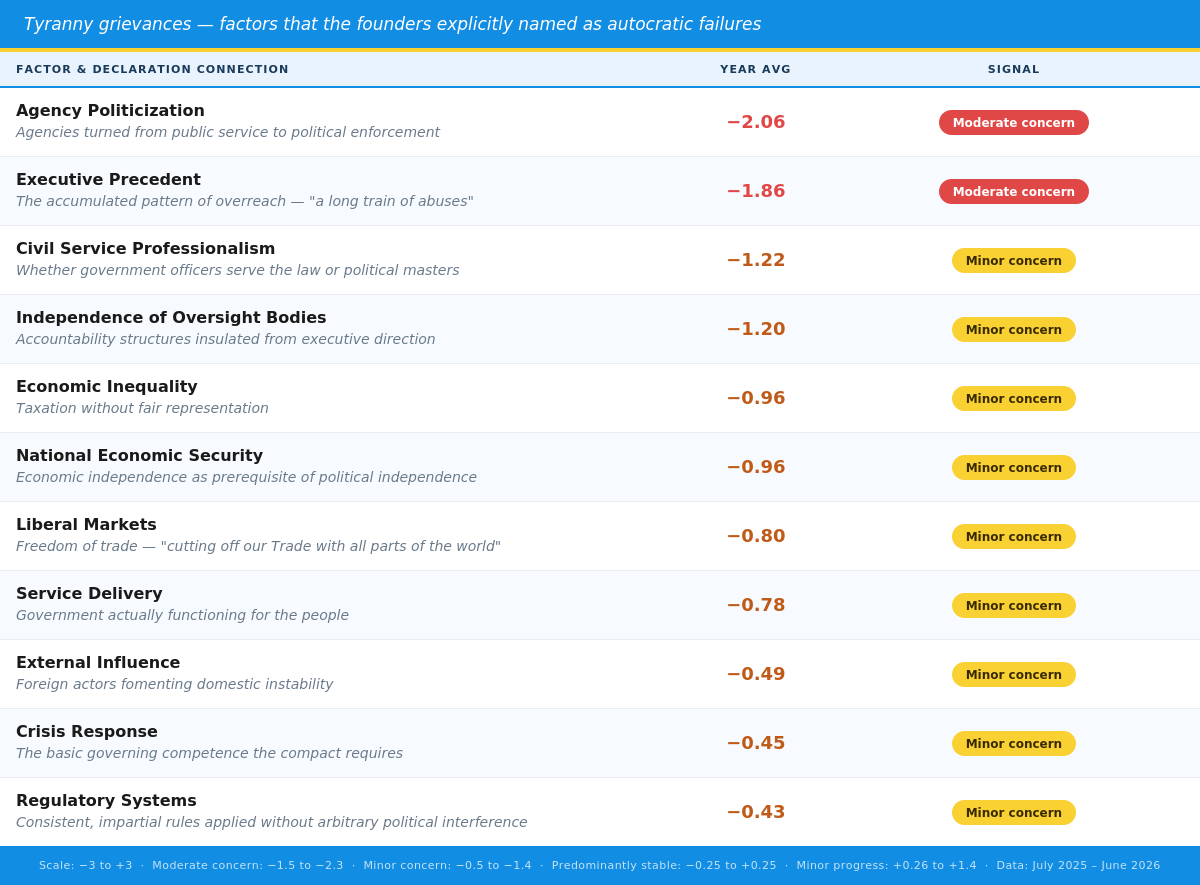
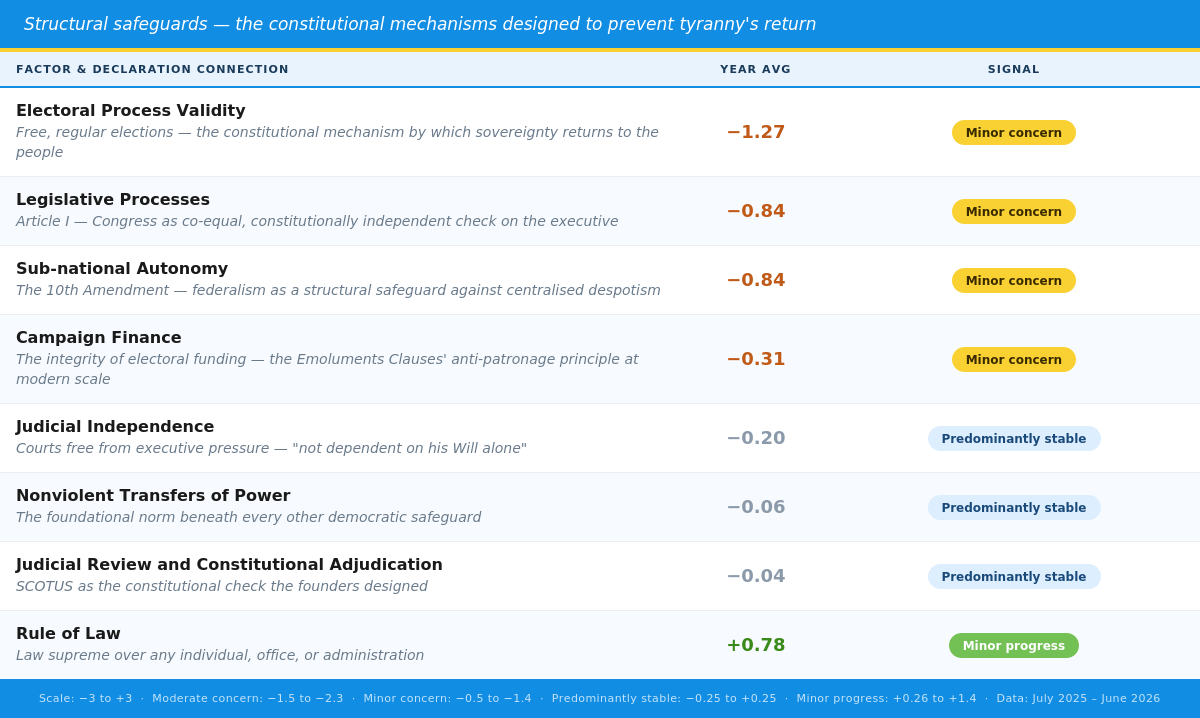
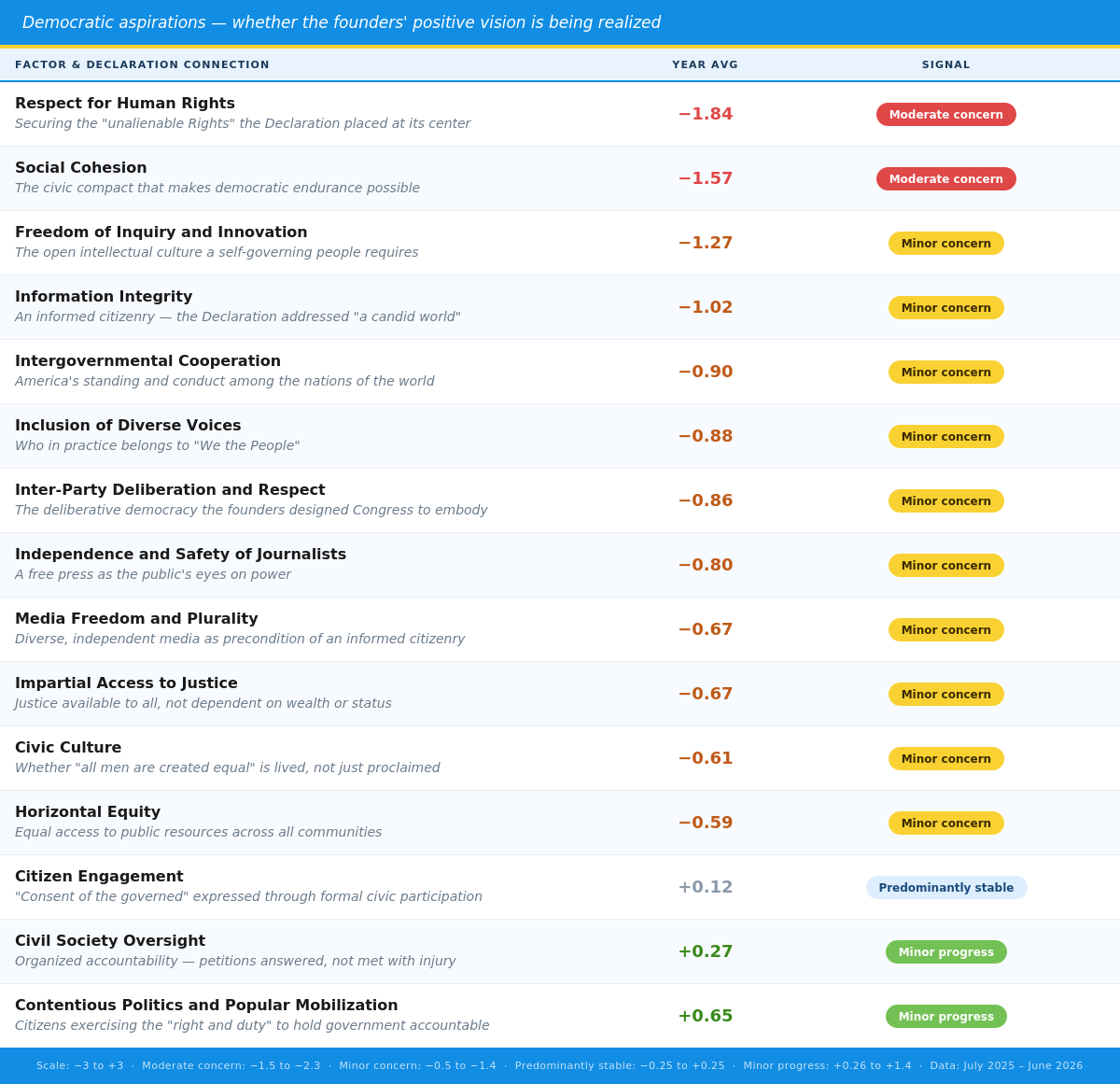
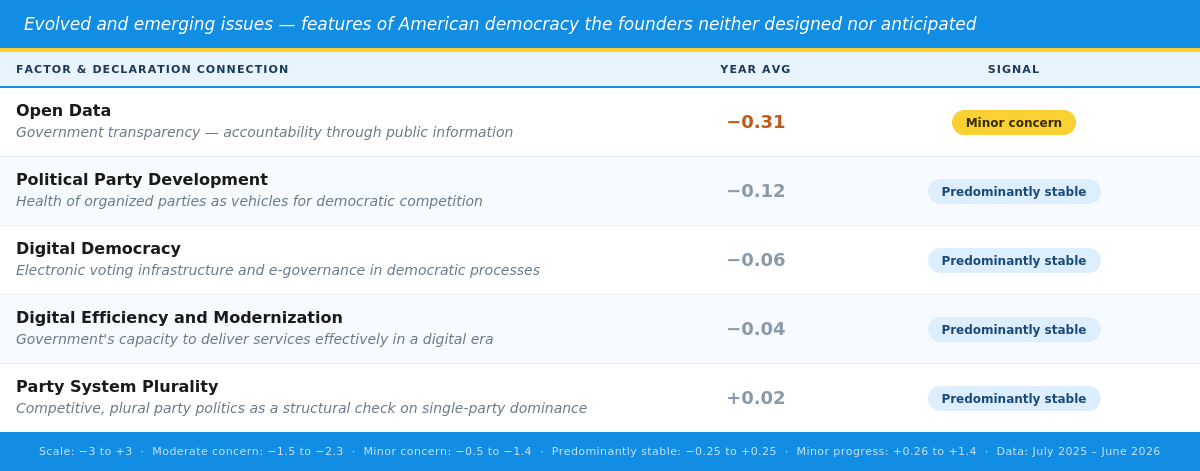
On the spectrum from the tyranny the founders fled (−3) to the democracy they desired to build (+3), the overall year average lands at −0.65 — clearly on the concerning side, but well short of the extreme conditions under which the founders chose to sever their political allegiance to the English king in 1776. The worst-scoring factor, Agency Politicization (−2.06), sits closest to the tyranny end. The best, Rule of Law (+0.78), is the republic’s strongest political accountability mechanism of the year. Between those extremes along the RealTime DemTrends average range spectrum at this 250-year anniversary milestone, Electoral Process Validity (−1.27), Legislative Processes (−0.84), and Sub-national Autonomy (−0.84) reflect stress across the nation’s constitutional safeguards, while Contentious Politics (+0.65) and Civil Society Oversight (+0.27) represent democracy’s immune system functioning as designed.
Five of our 39 factors — Political Party Development, Party System Plurality, Open Data, Digital Democracy, Digital Efficiency and Modernization — reflect unintended and unanticipated evolutions of the U.S. democratic system that founders could not have foreseen. The founders were so concerned about political factions that Madison devoted Federalist No. 10 to opining about the nature of faction rifts (e.g. polarization) in an effort to design a large representative democratic republic that would guard against them — yet parties emerged from President Washington's own cabinet within four years. The 12th Amendment quietly accommodated party-line voting in 1804. Two centuries later, the speed of transit and communication accelerated from horses to the airplane and post to the telegraph, internet, and now AI — bringing an entirely new set of democratic considerations into the discourse that the founders of 1776 could not have foreseen. These factors exist in our framework as a reflection of how much the project of self-governance has had to evolve. Notably, most of them sit close to stable in our data — suggesting that the stress on American democracy in 2025–2026 is concentrated in the original failures of autocratic rule that the founders had named, not in the modern institutional machinery they never anticipated.
The 250-Year Assessment
The aspiration endures. Even as our institutions weaken and tyranny knocks at our door.
The year-average score of −0.65 places the United States clearly on the concern side of our scale — but far from the extreme. No factor has reached significant concern. The institutional safeguards the founders designed are still functioning, though many are operating under pressure that our data registers as meaningful and sustained.
The pattern in the data is historically recognizable. The factors scoring worst — Agency Politicization, Executive Precedent, Respect for Human Rights, Social Cohesion — correspond almost precisely to the tyranny patterns the Declaration enumerated in 1776. The factors holding most strongly — Rule of Law, Contentious Politics, Civil Society Oversight — reflect the safeguards the founders put in place: courts checking power, citizens mobilizing, civic watchdogs functioning.
What this snapshot tells us is that the democratic experiment is ongoing, evolving, nuanced, and measurable — and that a republic whose citizens, courts, and civil society organizations are actively exercising the rights and duties the Declaration described has not abandoned its founding promise. What the data cannot tell us is whether those safeguards will be sufficient if we stay on this same trajectory.
The Declaration was written at a moment of crisis in government legitimacy for the colonists of the time, by people who had exhausted every possible channel of redress. What they built afterward — imperfect, contested, and gradually evolved and expanded over two and a half centuries — proved capable of enduring extraordinary systemic stress. Whether it endures this episode of strain depends, as it always has, on whether citizens exercise precisely the faculty the founders most insisted upon: the duty to hold government accountable, through every available institutional and civil channel, for as long as those channels remain open.
Painfully relevant, timely, and hope-inspiring. Thank you!
This is great, the best presentation of what's in the Declaration that I've seen!
I'm surprised by the positive Rule of Law score - over at Bright Line Watch, a survey of legal professionals finds American rule of law at the lowest level that respondents can remember. Any idea what's driving that difference?