

In the United States, as the oldest operational democracy, we often take our system for granted—assuming our votes get counted, laws get enforced, and constitutional checks endure. But as a Guatemalan official once told me about his country's democratic progress, "I think we've only reached the 'o' in D-E-M-O-C-R-A-C-Y." My reply: "I'm not sure any country has reached the 'y' yet." The state of US democracy, like all democracies, is constantly in flux.
As we approach the 250th anniversary of the Declaration of Independence, it's worth zooming out to examine how current events influence our democratic system. Monitoring democratic health in real-time isn't as simple as tracking approval ratings or election results. Democratic vitality depends on a complex ecosystem of institutions, norms, and practices that either strengthen or weaken the pillars of political accountability.
I've developed a comprehensive framework based on decades of political science research and extensive consultation with democracy practitioners worldwide. This framework tracks 39 factors across 13 key dimensions of US democratic health. But first, before I get into the nitty-gritty details, let’s get on the same page about the concept of political accountability.
The Foundation: Political Accountability
Political accountability is the cornerstone of democratic governance. Research from the Varieties of Democracy (V-Dem) Institute posits that the central feature of a strong democratic system is the ability to hold elected leaders accountable for decisions that influence citizens’ lives. They suggest that there are various channels through which political accountability is exercised, including but not limited to:
Vertical accountability involves citizens holding government accountable through elections and political parties. This is the traditional "ballot box" accountability that most people think of when we talk about our democratic system. It’s how individual citizens show up to vote or otherwise engage in political processes.
Diagonal accountability encompasses civil society, media, and social movements that monitor government actions and mobilize public pressure for responsiveness. Think here of how the social sector mobilizes to activate and support the government in response to disasters or fill market gaps, exercising free speech, and protest.
Horizontal accountability consists of checks and balances between branches of government. We often associate this kind of accountability with how the US Constitution defines the role of each branch, like legislatures overseeing executives or courts reviewing laws. But there are other institutions that fall into this bucket too, such as oversight bodies monitoring compliance.
All three forms must be present and robust for democracy to remain healthy. When one weakens, the others must compensate, and there are limits to how much any single channel can bear. If these three channels were legs on a stool, you can imagine what happens when one fails.

The reality is more complex. The US democratic system has nearly 40 distinct types of political accountability that researchers have identified. And I suspect that I’m still missing a few. Even when some forms break down, many others can keep the system largely balanced.

To understand what's happening—especially how real-time events impact the system—we need to unpack political accountability into its component parts.
Unpacking the Democratic Vitality System: 13 Dimensions and 39 Factors
Below are the dimensions and factors I will use to process weekly news and assess its impact on democratic health.
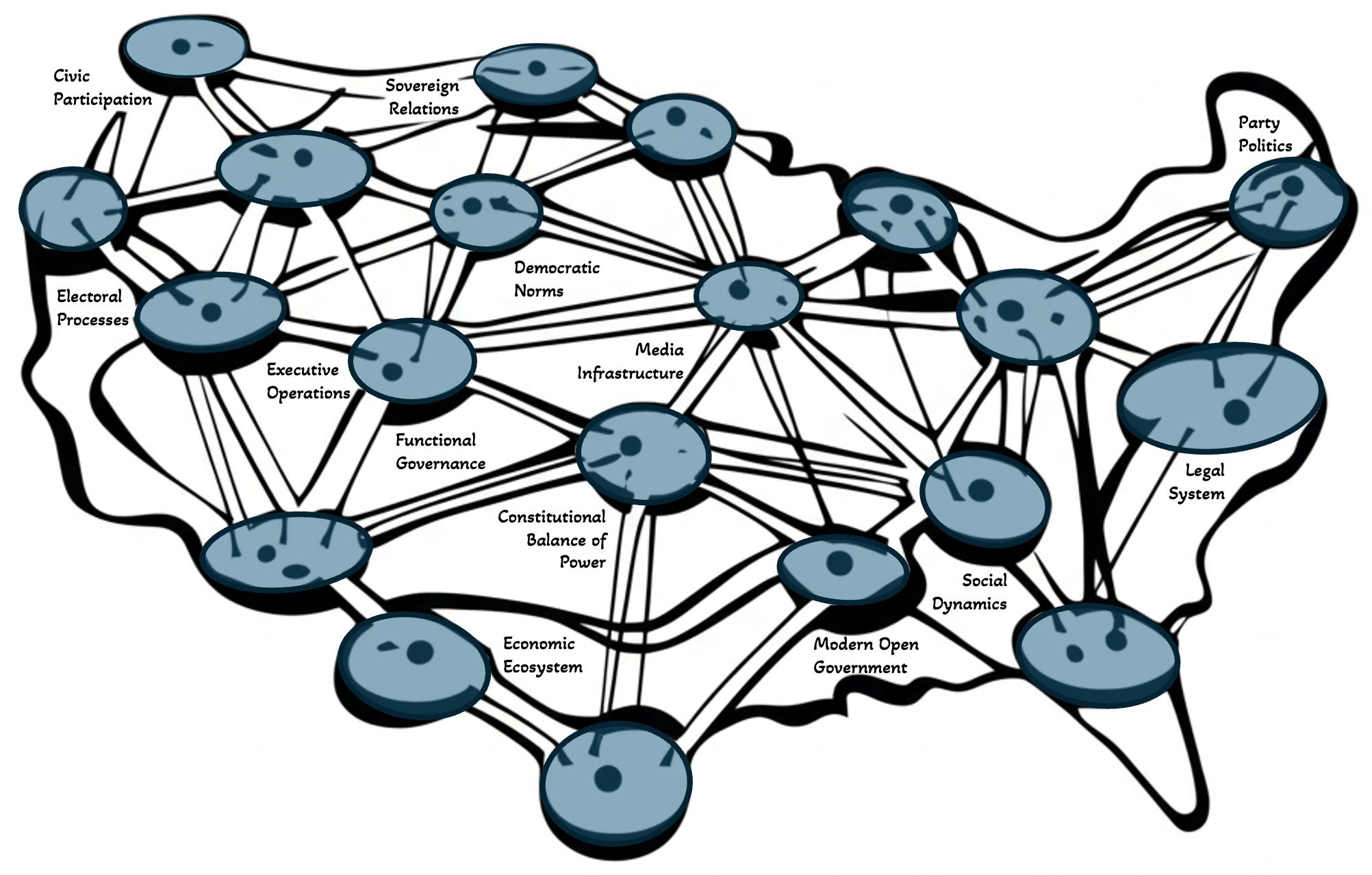
1. Social Dynamics
The foundation upon which political accountability rests is the composition and cohesion of society itself. Robert Putnam's research highlights how robust social bonds and a sense of shared community enable collective democratic engagement. When societies act to address divisions and inequities, they foster the conditions necessary for broad political participation. This dimension includes:
Social Cohesion: Trust within communities and between groups
Horizontal Equity: Fair distribution of public resources
Economic Inequality: Concentration of wealth and its political impacts
2. Democratic Norms
Strong democratic norms enable society to manage tension by focusing on shared values, including diverse voices, and protecting rights. As Almond and Verba describe, this ‘civic culture’ balances a complex mix of attitudes and orientations that maintain democratic stability through periods of strain or division. This dimension includes:
Civic Culture: Public support for and practice of democratic values
Inclusion of Diverse Voices: Meaningful representation of marginalized and minority groups
Respect for Human Rights: Protection of fundamental freedoms
3. Civic Participation
Citizens must have meaningful opportunities to engage with government as individuals and in organized groups. This dimension tracks both how citizens engage in electoral and political processes and come together in social movements or formal organizations within civil society to hold government leadership accountable beyond the election cycle—identified by Bermeo and others as a crucial check on democratic backsliding. This dimension includes:
Citizen Engagement: Voting patterns and civic involvement in political forums beyond elections
Contentious Politics and Popular Mobilization: Ability to exercise the right to peaceful protest and assembly
Civil Society Oversight: Independent organizations monitoring government activities and performance
4. Media Infrastructure
A free and diverse media system enables diagonal accountability by keeping citizens informed and investigating government actions. Research consistently shows media freedom correlates with democratic performance—as Karlekar and Becker's analysis demonstrates, press freedom is a "key component of the general level of democracy" and could even be a leading indicator of broader democratic decline. This dimension includes:
Independence and Safety of Journalists: Protecting media professionals from intimidation and violence
Media Freedom and Plurality: Diverse outlets across the political spectrum that operate independently from government control or pressure
Information Integrity: Media literacy and fact-checking capacity to counter untrue or misleading information
5. Party Politics
Political parties serve as crucial intermediaries between citizens and government, organizing political competition, gathering and responding to citizen preferences, and helping to ensure that the people’s voices are heard in the capital. Healthy party systems offer real choices and maintain democratic norms once candidates are elected to office too. As Rosenbluth, McCall, and Shapiro argue in their work on responsible parties, strong programmatic parties are essential for calculating policy trade-offs and maintaining long-term accountability that serves voters' interests. This dimension includes:
Political Party Development: Strong, disciplined parties with effective leadership capable of making coherent policy decisions
Inter-Party Deliberation and Respect: Constructive debate and mutual respect across party lines
Party System Plurality: Competitive electoral landscape with meaningful policy alternatives
6. Electoral Processes
Free and fair elections are the primary mechanism of vertical accountability. Research shows that even perceptions of electoral irregularities can undermine democratic legitimacy, as Norris demonstrates in her work on maintaining electoral integrity throughout the typical electoral cycle and between elections. From electoral code and procedures to transparent communication about results, the integrity of elections is essential for democratic stability. This dimension includes:
Electoral Process Validity: Free, fair, and accessible elections
Campaign Finance: Transparency and regulatory control over the undue influence of money in politics
Nonviolent Transfers of Power: Peaceful and smooth transitions between administrations
7. Economic Ecosystem
There’s a tenuous fine line between economic security and stability, on the one hand, and free and fair markets on the other. If the balance isn’t right, it can undermine the US democracy and the nation’s prosperity along with it. Research by Rodrik as well as Acemoglu and Robinson argues that institutional quality is crucial to economic growth and prosperity, although no single economic model is applicable to all contexts. This dimension includes:
National Economic Security: Balancing broader economic dynamism and global trade while protecting US security interests and infrastructure
Liberal Markets: Fair markets with reasonable regulation and consumer protection
Freedom of Inquiry and Innovation: Capacity to pursue independent inquiry and innovation, safeguarding academic freedom and fostering environments conducive to research and development
8. Modern Open Government
Modern democracies increasingly depend on technological tools that enhance transparency, participation, and efficiency. Leaning into the digital age opens the door to new forms of participation, while occasioning the need for new systems and norms for human oversight and appeal mechanisms. As Florini’s research on transparency highlights, disclosure is crucial to upholding all other rights. This dimension includes:
Open Data: Accessibility of government data and information
Digital Efficiency & Modernization: How technology streamlines or transforms administrative processes
Digital Democracy: Online participation forums, digital government services, and algorithmic systems that make ‘e-governance’ accessible and accountable
9. Legal System
The rule of law serves as the structural framework that enables and reinforces accountability across all democratic institutions. As O'Donnell’s research emphasizes, an effective and legitimate rule of law is an essential pillar upon which high-quality democracy rests, extending beyond formal legal processes. Independent courts and consistent legal application in law enforcement are also essential. This dimension includes:
Rule of Law: Equal application of legal standards that ensures political rights and civil liberties while constraining potential abuses of state power
Impartial Access to Justice: Accessible legal system that ensures that all individuals are treated fairly and with dignity in law enforcement and the courts
Judicial Independence: Courts operate freely from undue influence or political pressure and do not abuse their autonomy to pursue narrow interests
10. Executive Operations
Executive branch functionality and accountability requires professional standards, internal controls, and operational integrity to ensure accountability. Research by scholars such as Lewis, McCubbins and Schwartz, and Dahlström et al. points to the critical balance between political leadership and bureaucratic expertise. This dimension includes:
Independence of Oversight Bodies: Internal watchdogs like attorney generals operate with sufficient autonomy to provide credible checks on executive power
Civil Service Professionalism: Merit-based recruitment and career systems build institutional expertise and memory across political transitions
Agency Politicization: Striking the balance between political appointees and career officials to avoid negative impacts on performance and service delivery
11. Functional Governance
Government must be capable of addressing major challenges while maintaining democratic norms. Research conducted by the World Bank has documented significant service delivery failures by government, including democracies, around the world, demonstrating that effective governance requires balancing executive capacity to manage everyday operations as well as crises with appropriate oversight through monitoring and audit systems. This dimension includes:
Crisis Response: Effective emergency management that balances decisive action with emergency powers that remain time-limited and proportionate
Service Delivery: Professional provision of public services that reach all segments of the population equitably with systems to monitor and evaluate performance
Regulatory Systems: Fair oversight frameworks that establish clear rules while allowing appropriate flexibility to avoid undue burdens
12. Constitutional Balance of Power
The separation of powers as outlined in the US constitution should prevent concentration of authority and ensure horizontal accountability. However, research from Posner and Vermeule demonstrates that constitutional balance has shifted dramatically toward executive dominance, and Whittington further highlights how unwritten, informal constitutional conventions are also susceptible to erosion. It is therefore essential to monitor the power balance across branches. This dimension includes:
Legislative Processes: Congress's ability to enact legislation, provide oversight, and check executive authority beyond stalling or blocking executive initiatives
Executive Precedent: Norms and limits on presidential power that prevent the executive from skirting legal checks while facilitating responsive governance
Judicial Review and Constitutional Adjudication: Established legal checks through the Supreme Court and constitutional conventions and interpretation
13. Sovereign Relations
Bottom-up and external pressures can strengthen or weaken national leader accountability through overlapping areas of interest, shared responsibilities, and diplomatic influence. Various researchers, like those featured in this edited volume and special issue, have mapped out how these complex multi-level arrangements can impact accountability through collaboration, complementary roles, and transparency around policy differences. This dimension includes:
Sub-national Autonomy: Striking a functional balance between national and state authority preserving local decision-making, sufficient resources, and room for policy experimentation while ensuring smooth national coordination
External Influence: Globalization requires resilience against foreign interference in domestic elections, public discourse, and policy decisions
Intergovernmental Cooperation: Clear responsibilities across government levels help citizens identify which authorities are responsible for specific outcomes
Limitations and Ongoing Refinement
This framework is a tool to help us filter the vast amount of information coming at us through the news each week to help us focus on the events and dynamics that matter for the health of the US democratic system. But, as with all frameworks, it has limitations:
Measurement challenges: To guide an AI-facilitated analysis of newsworthy events each week, I have trained AI on a set of hypothetical scenarios that could reflect positive or negative shifts across the 39 factors nested into these 13 dimensions. But scenarios are conceptually ‘fuzzy’ because there is not a consistent, or even measurable, increment between each set of scenarios that I’ve designated as representative of a minor - moderate - significant shift.
Temporal effects: I’m attempting to measure changes in each dimension weekly, but events tend to unfold over several weeks. For example, legislation may be proposed one week, but not actually passed until several weeks later. In these types of cases, I will err on the conservative side by flagging a minor shift as an event begins to unfold and later reflecting a moderate or significant shift as the details of the event and its impacts become more apparent or concrete.
Interaction effects: The relationships between dimensions are complex, so AI and I will do my best to pick the dimension and factor that most accurately captures each event. Please add a comment or join my (volunteer) review team to help refine the system of classification.
Every week of this experiment thus far, I’ve found ways to further refine the approach based on new research, AI model fine-tuning, feedback from experts, and watching how reported events (and opinions about them) evolve over time. Remember: this is a test. So, please expect things to change, hopefully for the better, each round.
Why This Matters
In an era of political polarization, we need shared standards for evaluating democratic health that transcend partisan perspectives. This framework provides:
Comprehensive systems view that avoids getting stuck in tunnel vision on a single issue
Common vocabulary for discussing levers and key stakeholders within a democratic system
Early warning or vital signs for possible threats to address or opportunities to leverage
Research foundation grounded in empirical evidence rather than opinion
Only by understanding the system's actual condition can we work together to strengthen it.
Have questions about specific dimensions or factors? See gaps in the framework? Your expertise and feedback help make this monitoring system more accurate and useful.